
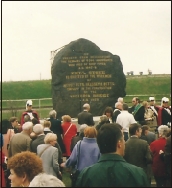
Montreal's Black Rock commemorates 5,000 who died in fever sheds on a spit of land where the foot of the Victoria Bridge now stands. Bridge workers erected the monument despite complaints from the Canadian National Railway.
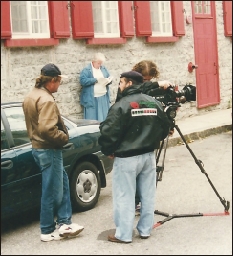
Marianna O'Gallagher prepares for an interview on Champlain Street, the old Irish quarter of Quebec City.
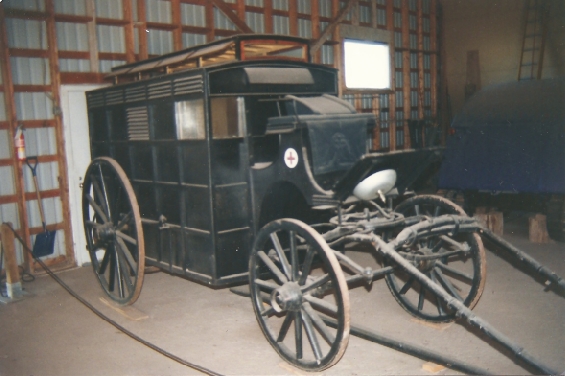
The only ambulance on Grosse Isle.
RTS PRODUCTIONS presents
THE STORY: After the Famine, the arrival of the Famine Irish settlers
Transported in coffin ships often under confinement, the emigrants
sailed from Ireland first to Saint John’s harbor and onward
into the mouth of the St. Lawrence River to Grosse Isle, and then,
in every sense of the term, up the river. The story of the famine
Irish is a tale of the unwanted, who were desperately seeking hope
and a new life in the new world.
While some historians say that the Irish blended into the fabric of Canada so well they were able to erase their past horror, others call this notion a denial of the facts and ask why so few, outside Quebec, claim to be descendants of these “boat people”.
Canadian Government officials did not recognize the economic basis for immigrant dependency during the summer of 1847 “but blamed the Irish themselves—their laziness and lack of ambition — for the difficulties they encountered during their transatlantic crossing and upon their arrival in Canada.”
The potato, easily grown, cultivated and prepaed, had quickly become the food staple of choice for the Irish peasants since its introduction from South America several centuries earlier. Its acceptance as a primary food source led to a significant increase in the population of the West counties who had been and were largely subsistance farmers who literally lived off the land, paying absentee landlords what little remained of their meager income. The coming of the blight would drastically and in short order change the demographic of the West counties by starving out its inhabitants in the space of two short years. Imagine a rice-less Asia or a wheat-less Europe to attain some idea of the magnitude of the crisis.
So when the potato famine struck Ireland it would prove to be the
perfect catalyst to set in motion the largest mass migrations in
history. Ireland wasn’t starving, her peasantry was. In fact
more food was being exported to England than ever… food that
peasants had never, could never and would never afford. The dubious
and wholly inadequate social assistance programs in place did nothing
more than reinforce the notion that salvation from starvation and
death lay in flight from famine.
The arrival of the blight was concurrent with socio-political upheaval
across the European continent, the rapidly approaching industrial
revolution and an increasingly popular notion in Great Britain of
divinely sanctioned “improvements” of the land holdings
of the gentry for the benefit of all. This British notion held that
the vast holdings of the gentry were being abused by the tenant
peasants through inbred idleness, ignorance and for lack of a better
phrase, freeloading at the Earl’s expense. More profit could
be made off estate holdings with the introduction of modern animal
husbandry and improved crop development programs. This of course,
necessitated the removal or relocation of the indigenous people.
Luckily for the gentry, they had a successful model for such an
endeavor in the Highland Clearances of Scotland at Culloden which
had been well underway for almost 80 years as punishment for the
Jacobite rebellion.
Marianna O'Gallagher is Quebec's leading historian on the origins
of the Irish community. Her father was a leader of the Ancient Order
of Hibernians, a traditional Irish fraternal society, ando was the
driving force that placed the Celtic Cross on Grosse Isle. She is
following in his footsteps and was instrumental in opening this
island to the public in the 1980s.
In her extensive history of Grosse Isle, O’Gallagher recorded one effort by a child who kept not only his name but a part of his family: “One such child was Daniel Tye and his sister who were adopted by the Coulombe Family at the urging of their parish priest. In addition to leaving them their names, M. Coulombe left them his holdings so that today, the Tye family figures prominently in the Irish Diaspora of Quebec.”
At every stop, the Famine Irish experienced a similar scenario: quarantined ships followed by fever sheds. The sick were hospitalized, the dead were buried and the survivors either escaped into the countryside or if they passed the health inspectors, were boarded onto a flotilla of vessels to move on further up the St. Lawrence. Most made it to Grosse Isle, a picture-pretty island 25 km downstream from Quebec City, set up as a mandatory quarantine station for immigrants coming to Canada. For the British governors, with their military cannons threatening any vessel that would not halt at their authority, Grosse Isle was a solution to the spread of typhus and cholera. For the Americans, it was a model to copy in building Ellis Island.
Many came to aid and comfort the sick and dying but records indicate
the Irish were, by and large, feared and unwanted… an influx
of sick and desperate people, most of whom could speak neither English
nor French. In fact even those who were considered healthy were
deemed of no use. At some places along the way, the Irish were treated
with compassion with notable heroic gestures from Doctor Douglas
at Grosse Isle and Mayor Mills of Montreal as well as the generosity
of the French-Canadian population. Records show that over three
hundred orphans were adopted by French Canadian rural folk. Some
of these children were permitted to keep their Irish surnames. As
a consequence we have some record of their fate. A larger number
of children were not permitted the luxury of keeping their Irish
heritage and were blended into the milieu.
Economic and expansionist concerns of the time demanded the construction
of an elaborate canal system to ship goods and people west. As a
consequence, Irish workers were called on for stone work. In Cornwall,
earlier immigrants between 1834-1842 dug to a depth of 9 feet. Over
the years, Cornwall canals were enlarged. By 1904, they descended
to 14 feet for 11 miles. Today Seaway dams have turned these labour-intensive
stone structures into tourist sites. Only a few of the originals
in Canada remain as transportation routes.
Canadian folk historian Sean D’Arcy who researched the trails of Ontario, tried to find the Famine Irish. “These people were feared because of the horrors that had beset them and they were also, in some sense, ‘political exiles’. They could be seen as a threat to the relative security that their kinsmen had fought so hard to establish. Anyone that survived and settled was clearly not inclined to say they came in ’47. Over successive generations, there developed a cultural amnesia that firmly set in, distancing survivors and descendants from their roots.” Retracing the path of the Famine Irish, Alec MacLeod met with Tony O’Laughlin, a young expat Irishman with a burning curiosity about the fate of those of Black ’47. He has lobbied Kingston city council and a local businessman to dedicate a historical Famine monument along the waterfront. It is the site where fever sheds were relocated after the city gentry protested their original placement. The site is now a parking lot.
A number of community researchers have found physical remain that
point to a harsh view of the events.In Toronto and other centers
in Upper Canada, settlers gathered to protest the presence of the
Irish famine victims and encouraged local city councils to close
down the fever sheds. “They arrived in late August, early September…
by the boat load. It’s hard to imagine… their survival
for over two months. Where was the help? We hear a lot about Grosse
Isle and the heroics in Montreal, Cornwall and Kingston, but why
is it they had to come this far? And this wasn’t the end of
the trail,” notes Toronto researcher Tom Gallagher.
What became of these poor unfortunates? A few mass graves mark the
end for about a third or as much as half of them. Many of these
sites were only commemorated well after interment, as though in
guilty afterthought. Today, plaques from Parks Canada and local
historical societies stand in remembrance from Saint John’s
to Windsor. These are the guide posts on this waterway story that
mark the forgotten trail.
Some researchers contend that many of the Irish were successful at integrating and did their utmost to create a new life, but left no traces of their past... Somehow this self-willed selective amnesia suggests that the survivors integrated themselves into the new society in a desperate effort to endure, kept their Irish identity but intentionally forgot their recent humbling past – a very un-Irish trait. Other scholars point to those who fled south of the border in the hope of finding relatives there. Industrialist Henry Ford’s grandfather, President John F. Kennedy’s great grandfather and activist/senator Tom Hayden’s ancestors were passengers onboard the coffin ships. To be interviewed, Hayden recounts: “All my great-grandparents were famine Irish. My parents never talked about it, but they too were shaped by the famine. I have no idea how much time my great grandparents spent in Canada. I suppose they might have traveled up the St. Lawrence like so many others and crossed over at Cornwall or maybe Windsor…I guess I’ll never know.”
And while many perished, there were indeed many who survived and prospered, choosing not to leave an oral history, akin to returned war veterans with tales they are incapable of telling. As a consequence, many Irish descendants in Canada today are unsure of their past. Could this deliberate cultural amnesia be borne of guilt and shame or are there other reasons for this historical vacuum? This is one of the many questions that After the Famine will explore.
The above After the Famine text is Registered and Copyrighted by RTS Canada, reprinted by permission. This text may not be reproduced without written consent.